Themed Photo Gallery & Information: Port Gibson
Background
Port Gibson is a city in Claiborne County, Mississippi, United States. The population was 1,567 at the 2010 census. Port Gibson is the county seat of Claiborne County, which is bordered on the west by the Mississippi River. It is the site of the Claiborne County Courthouse.
The first European settlers in Port Gibson were French colonists in 1729; it was part of La Louisiane. It was chartered as a town in 1803 after the United States acquired the territory in the Louisiana Purchase from France. To develop cotton plantations in the area after Indian Removal of the 1830s, planters in the state imported thousands of African-American slaves from the Upper South. The county had a black majority established well before the Civil War; they were overwhelmingly enslaved.
Several notable people are natives of Port Gibson. The town saw action during the American Civil War. Port Gibson has several historical sites listed on the National Register of Historic Places (National Register of Historic Places listings in Claiborne County, Mississippi).
In the 20th century, Port Gibson was home to The Rabbit’s Foot Company. It had a substantial role in the development of blues in Mississippi, including taverns and juke joints now included on the Mississippi Blues Trail.
With the decline in agriculture and lack of other jobs, the city and rural county have suffered from reduced population and poverty. The peak of population in the city was in 1950. A report in the New York Times in 2002 characterized Port Gibson as 80 percent black and poor, with 20 percent of families living on incomes of less than $10,000 a year, according to the 2000 Census. It also has an “entrenched population of whites, many of whom are related and have some historical connection to cotton.”
Chartered as a town on March 12, 1803, Port Gibson is Mississippi’s third-oldest European-American settlement. It was developed beginning in 1729 by French colonists, and was then within French-claimed territory known as La Louisiane.
More Americans entered the area following the US acquisition and Indian Removal in the 1830s. Planters developed cotton plantations of the fertile river lowlands of the Mississippi Delta. As the planter population increased, they founded the Port Gibson Female College here in 1843. The college closed, and one of its buildings now serves as the city hall.
Port Gibson was the site of several clashes during the American Civil War and figured in Ulysses S. Grant’s Vicksburg Campaign. The Battle of Port Gibson occurred on May 1, 1863, and resulted in the deaths of over 200 Union and Confederate soldiers. The battle was a turning point in the Confederates’ ability to hold Mississippi and defend against an amphibious attack. Port Gibson is the site of the Port Gibson Oil Works, a cottonseed oil plant.
Many of the town’s historic buildings survived the Civil War because Grant reportedly proclaimed the city to be “too beautiful to burn”. These words appear on the town’s city limits signs. Historic buildings near the city include the Windsor Ruins, which have been shown in several motion pictures.
Gemiluth Chessed synagogue, built in 1892, had an active congregation when the town was thriving as the parish seat. It is the oldest synagogue and the only Moorish Revival building in the state. The Jewish population gradually moved to larger cities and areas offering more opportunity as the economy changed, and none remain in Port Gibson.
The Rabbit’s Foot Company was established in 1900 by Pat Chappelle, an African-American theatre owner in Tampa, Florida. This was the leading traveling vaudeville show in the southern states, with an all-black cast of singers, musicians, comedians and entertainers.
After Chappelle’s death in 1911, the company was taken over by Fred Swift Wolcott, a white farmer. He based the touring company in Port Gibson after 1918, and continued to manage it until 1950. The Rabbit’s Foot Company remained popular, but was no longer considered “authentic.”
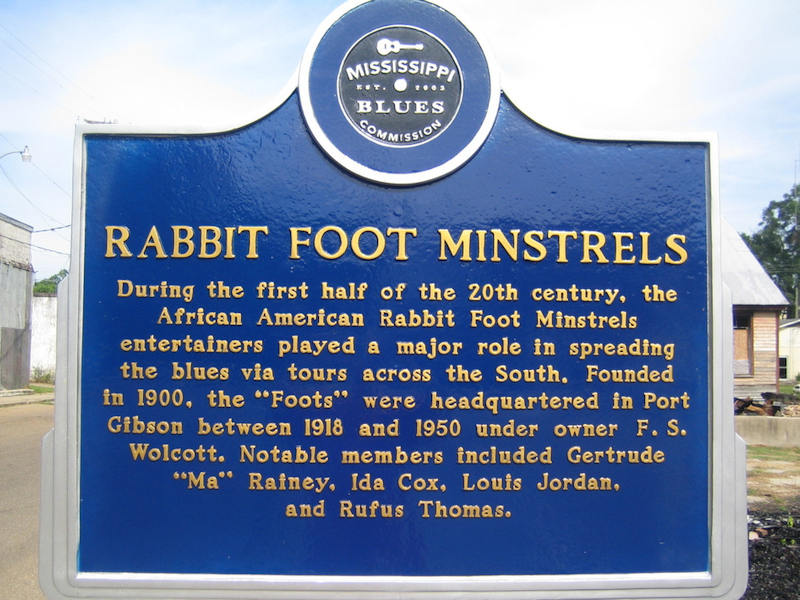
The Mississippi Blues Commission has placed a marker in Port Gibson to recognize The Rabbit’s Foot Company as important on the Mississippi Blues Trail. The marker commemorates the contribution the company made to the development of the blues in Mississippi, in its decades of operation after the founder’s death.
Source: Wikipedia
The Rabbit’s Foot Company
The Rabbit’s Foot Company, also known as the Rabbit(‘s) Foot Minstrels and colloquially as “The Foots”, was a long-running minstrel and variety troupe that toured as a tent show in the American South between 1900 and the late 1950s. It was established by the African-American entrepreneur Pat Chappelle and taken over after his death in 1911 by Fred Swift Wolcott. It provided a basis for the careers of many leading African-American musicians and entertainers, including Arthur “Happy” Howe, Ma Rainey, Ida Cox, Bessie Smith, Butterbeans and Susie, Tim Moore, Big Joe Williams, Louis Jordan, Brownie McGhee, Rufus Thomas, and Charles Neville.
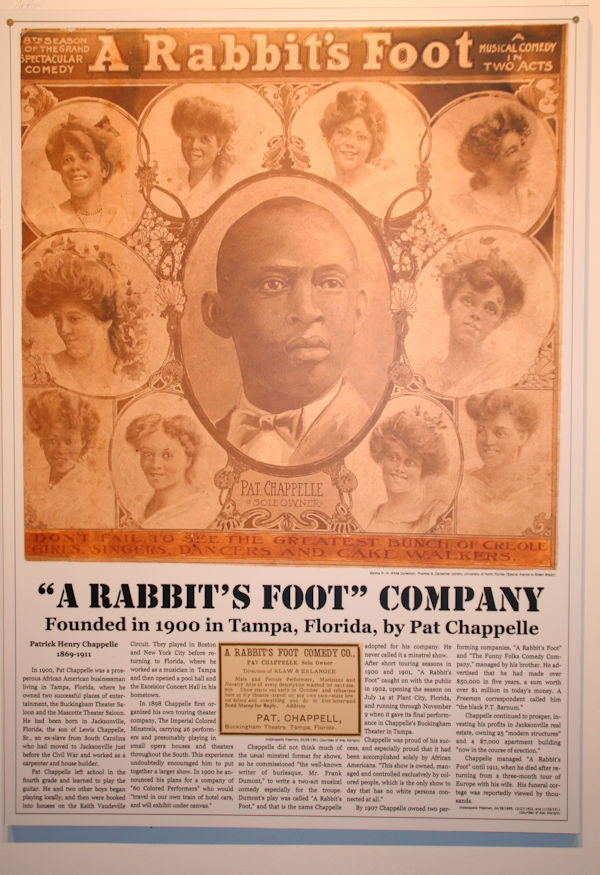
The company was founded, organised, originally owned and managed by Pat Chappelle (1869–1911), an African-American former string band guitar player and entrepreneur originally from Jacksonville, Florida, who established a small chain of theatres in the late 1890s. In 1898, Chappelle organised his first traveling show, the Imperial Colored Minstrels (or Famous Imperial Minstrels), which featured the comedian Arthur “Happy” Howe and toured successfully around the South. Chappelle also opened the Excelsior Hall in Jacksonville, the first black-owned theater in the South, which reportedly seated 500 people. In 1899, he closed the theater and moved to Tampa, where he and the African-American entrepreneur R. S. Donaldson opened a new vaudeville house, the Buckingham, in the Fort Brooke neighborhood, soon followed by a second theatre, the Mascotte.
The success of their shows at the Buckingham and Mascotte theatres led Chappelle and Donaldson to announce their intention, in early 1900, to establish a traveling vaudeville show. Chappelle commissioned Frank Dumont (1848–1919), of the Eleventh Street Theater in Philadelphia, to write a show for the new company. Dumont was an experienced writer for minstrel shows, who “wrote perhaps hundreds of skits and plays”. A Rabbit’s Foot had little plot; a newspaper at the time said that it “is an excellent vehicle for the presentation of an abundant amount of rag-time, sweet Southern melodies, witty dialogue, buck dancing, cake walks, and numerous novelties”.
In May 1900, Chappelle and Donaldson advertised for “60 Colored Performers… Only those with reputation, male, female and juvenile of every description, Novelty Acts, Headliners, etc., for our new play ‘A Rabbit’s Foot’…. We will travel in our own train of hotel cars, and will exhibit under canvas”. In summer 1900, Chappelle decided to put the show into theatres rather than under tents, first in Paterson, New Jersey, and then in Brooklyn, New York. However, his bandmaster, Frank Clermont, left the company, his partnership with Donaldson dissolved, and business was poor. In October 1901, the company launched its second season, with a roster of performers again led by the comedian Arthur “Happy” Howe, and toured in Alabama, Mississippi, Georgia and Florida. The show grew in popularity throughout the early years of the century, playing in both theatres and tents. Trading as Chappelle Bros., Pat Chappelle and his brothers, James E. Chappelle and Lewis W. Chappelle, rapidly organised a small vaudeville circuit, including theatre venues in Savannah, Georgia, Jacksonville and Tampa. By 1902 it was said that the Chappelle brothers had full control of the African-American vaudeville business in that part of the country, “able to give from 12 to 14 weeks [of employment] to at least 75 performers and musicians” each season.
Chappelle stated, late in 1902, that he had “accomplished what no other Negro has done – he has successfully run a Negro show without the help of a single white man.” As his business grew, he was able to own and manage multiple tent shows, and the Rabbit’s Foot Company traveled to as many as sixteen states in a season. Chappelle was known for creating exciting shows, often coordinated with parades, or parades were organized around his show’s appearances, and the Rabbit’s Foot Company drew large crowds. The shows included minstrel performances, dancers, circus acts including “daring aerialists”, comedy, musical ensembles, drama and classic opera. The show was known as one of the few “authentic negro” vaudeville shows around. It traveled most successfully in the southeast and southwest, and also to Manhattan and Coney Island. Chappelle also established an all-black baseball team, which toured with the company and played the local team in each city the company visited. The team operated until at least 1916.
By 1904 the Rabbit’s Foot show featured more than 60 quality performers, had expanded to fill three Pullman railroad carriages, and was describing itself as “the leading Negro show in America”. For the 1904–1905 season, the company included week-long stands in Washington, D.C., and Baltimore, Maryland. Two of its most popular performers were the singing comedian Charles “Cuba” Santana and the trombonist Amos Gilliard, though the latter defected to Rusco and Holland’s Georgia Minstrels and claimed that Pat Chappelle and his brothers had threatened him at gunpoint before throwing him off the company train. Another performer, William Rainey, brought his young bride, Gertrude – later known as Ma Rainey – to join the company in 1906. That year, Chappelle launched a second travelling tent company, the Funny Folks Comedy Company, with performers alternating between the two companies. The business continued to expand, though, following a dispute, Lewis and James Chappelle left the company around 1907, and in August 1908 one of the Pullman carriages used by the show burned to the ground in Shelby, North Carolina, while several of the vaudeville entertainers were asleep. The fire occurred when one of their horses kicked over a tank of gasoline near a cooking stove. Chappelle quickly ordered a new carriage and eighty-foot round tent so the show could go on the following week.
Pat Chappelle died from an unspecified illness in October 1911, aged 42. At his death, he was said to be “one of the wealthiest colored citizens of Jacksonville, Fla., owning much real estate”. His widow, Rosa, remarried and sold the Rabbit’s Foot Company as a going concern.
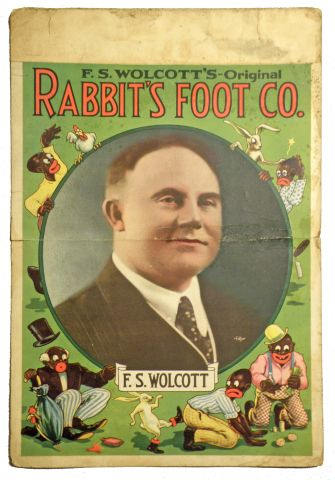 The Rabbit’s Foot Company was bought in 1912 by Fred Swift Wolcott (1882–1967), a white farmer originally from Michigan, who owned a small carnival company, F. S. Wolcott Carnivals, and put on a touring show, “F. S. Wolcott’s Fun Factory”, based in Columbia, South Carolina.
Wolcott maintained the Rabbit’s Foot company as a touring show, initially as both owner and manager, and attracted new talent, including the blues singer Ida Cox, who joined the company in 1913. Ma Rainey also brought the young Bessie Smith into the troupe and worked with her until Smith left in 1915. The show’s touring base moved to Wolcott’s 1,000-acre Glen Sade Plantation, outside Port Gibson, Mississippi, in 1918, with offices in the center of town. Wolcott began to refer to the show as a “minstrel show” – a term Chappelle had eschewed. A member of his company, the trombonist Leon “Pee Wee” Whittaker, described him as “a good man” who looked after his performers.
Each spring, musicians from around the country assembled in Port Gibson to create a musical, comedy, and variety show to perform under canvas. In his book The Story of the Blues, Paul Oliver wrote:
The ‘Foots’ travelled in two cars and had an 80′ x 110′ tent which was raised by the roustabouts and canvassmen, while a brass band would parade in town to advertise the coming of the show….The stage would be of boards on a folding frame and Coleman lanterns – gasoline mantle lamps – acted as footlights. There were no microphones; the weaker voiced singers used a megaphone, but most of the featured women blues singers scorned such aids to volume.
The company, by this time known as F. S. Wolcott’s Original Rabbit’s Foot Company or F. S. Wolcott’s Original Rabbit’s Foot Minstrels, continued to perform annual tours through the 1920s and 1930s, playing small towns during the week and bigger cities on weekends. Louis Jordan performed with the troupe in the 1920s, sometimes with his father, a bandleader. Other performers with the company in the 1930s included the young Rufus Thomas, George Guesnon, and Leon “Pee Wee” Whittaker. Later, Maxwell Street Jimmy Davis also toured with the troupe.
In 1943 Wolcott placed an advertisement in Billboard, describing the show as “the Greatest Colored Show on Earth” and seeking “Comedians, Singers, Dancers, Chorus Girls, Novelty Acts and Musicians”. Wolcott remained its general manager and owner until he sold the company in 1950, to Earl Hendren, of Erwin, Tennessee.
In turn, Hendren sold the operation in 1955 to Eddie Moran, of Monroe, Louisiana, where it was based in its final years. In 1956, it was reported to be still trading under Wolcott’s name and “playing under canvas and making mostly one-day stands… bringing live entertainment of a style most show people don’t dream still exists and flourishes.” The show at that time featured the blues singer Mary Smith and the comedian Memphis Lewis and had a payroll of 50, including a ten-strong band. Performances included “up-to-the-minute rock-and-roll” and an “exotic dancer”. Records suggest that the company’s last performance was in 1959. The company’s trucks, buses and trailers were seized by the sheriff of Ouachita Parish in Monroe in 1960, under a writ of fieri facias, and sold.
A historical marker has been placed in Port Gibson, Mississippi, by the Mississippi Blues Commission, as part of the Mississippi Blues Trail, commemorating the contribution of the Rabbit’s Foot Company to the development of the blues in Mississippi.
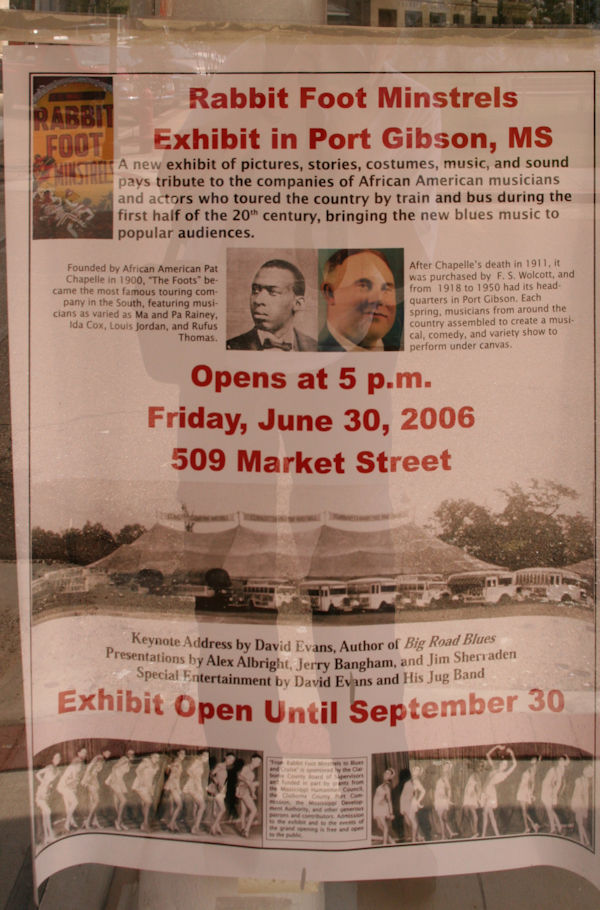
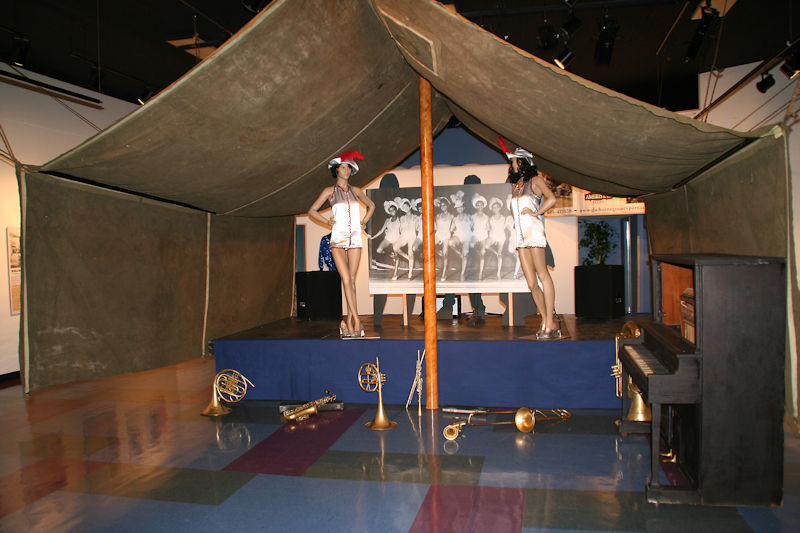
In 2006, an exhibition, The Blues in Claiborne County: From Rabbit Foot Minstrels to Blues and Cruise, was shown in Port Gibson, exploring the history of the show, with artifacts and memorabilia.
Source: Wikipedia
Mississippi Blues Trail Markers
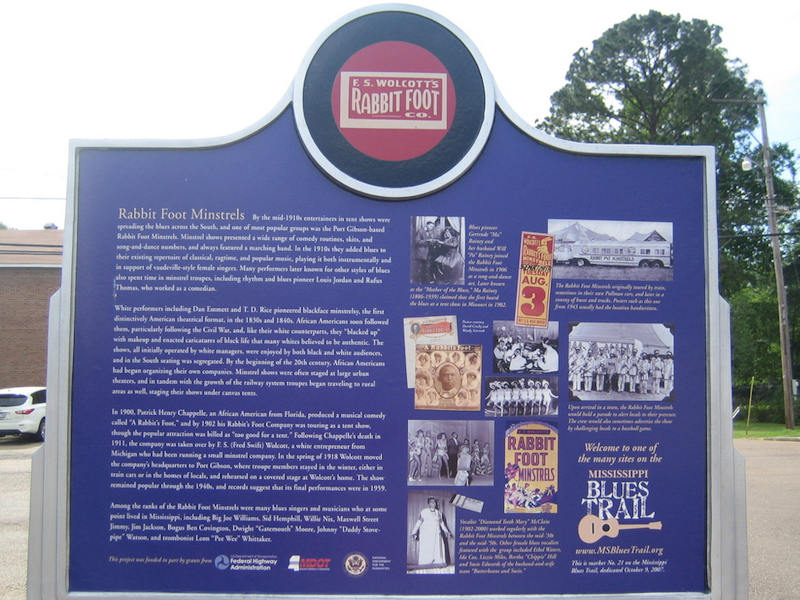
Full text:
During the first half of the 20th century, the African American entertainers of the Rabbit Foot Minstrels played a major role in spreading the blues [via tours across the South]. Founded in 1900, the “Foots” were headquartered in Port Gibson between 1918 and 1950 under owner F.S. Wolcott. Notable members included Gertrude “Ma” Rainey, Ida Cox, Louis Jordan, and Rufus Thomas.
By the mid-1910s entertainers in tent shows were spreading the blues across the South, and one of most popular groups was the Port Gibson-based Rabbit Foot Minstrels. Minstrel shows presented a wide range of comedy routines, skits, and song-and-dance numbers, and always featured a marching band. In the 1910s they added blues to their existing repertoire of classical, ragtime, and popular music, playing it both instrumentally and in support of vaudeville-style female singers. Many performers later known for other styles of blues also spent time in minstrel troupes, including rhythm and blues pioneer Louis Jordan and Rufus Thomas, who worked as a comedian.
White performers including Dan Emmett and T. D. Rice pioneered blackface minstrelsy, the first distinctively American theatrical format, in the 1830s and 1840s. African Americans soon followed them, particularly following the Civil War, and, like their white counterparts, they “blacked up” with makeup and enacted caricatures of black life that many whites believed to be authentic. The shows, all initially operated by white managers, were enjoyed by both black and white audiences, and in the South seating was segregated. By the beginning of the 20th century, African Americans had begun organizing their own companies. Minstrel shows were often staged at large urban theaters, and in tandem with the growth of the railway system troupes began traveling to rural areas as well, staging their shows under canvas tents.
In 1900, Patrick Henry Chappelle, an African American from Florida, produced a musical comedy called “A Rabbit’s Foot,” and by 1902 his Rabbit’s Foot Company was touring as a tent show, though the popular attraction was billed as “too good for a tent.” Following Chappelle’s death in 1911, the company was taken over by F. S. (Fred Swift) Wolcott, a white entrepreneur from Michigan who had been running a small minstrel company. In the spring of 1918 Wolcott moved the company’s headquarters to Port Gibson, where troupe members stayed in the winter, either in train cars or in the homes of locals, and rehearsed on a covered stage at Wolcott’s home. The show remained popular through the 1940s, and records suggest that its final performances were in 1959.
Among the ranks of the Rabbit Foot Minstrels were many blues singers and musicians who at some point lived in Mississippi, including Big Joe Williams, Sid Hemphill, Willie Nix, Maxwell Street Jimmy, Jim Jackson, Bogus Ben Covington, Dwight “Gatemouth” Moore, Johnny “Daddy Stovepipe” Watson, and trombonist Leon “Pee Wee” Whittaker.
Photo Gallery
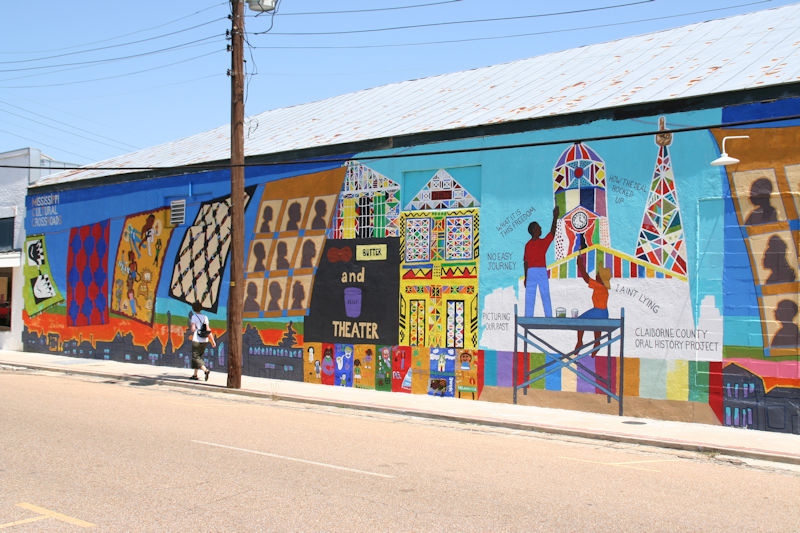
In late September 2006, I was fortunate to be involved in a book signing tour of the USA which included a visit to the Rabbit Foot Exhibition “The Blues in Claiborne County: From Rabbit Foot Minstrels to Blues and Cruise” (mentioned in the Wikipedia article above)at the Mississippi Cultural Crossroads arts agency in Port Gibson (this tour is documented in an EarlyBlues travelogue “Railroadin’ Some” Book Signing Tour : Tennessee, Mississippi & Arkansas” by Max Haymes). Here are some photos from the visit:
Mississippi Cultural Crossroads arts agency:
Poster advertising the exhibition:
Sample of storyboard exhibit:
Advert of the Minstrels show:
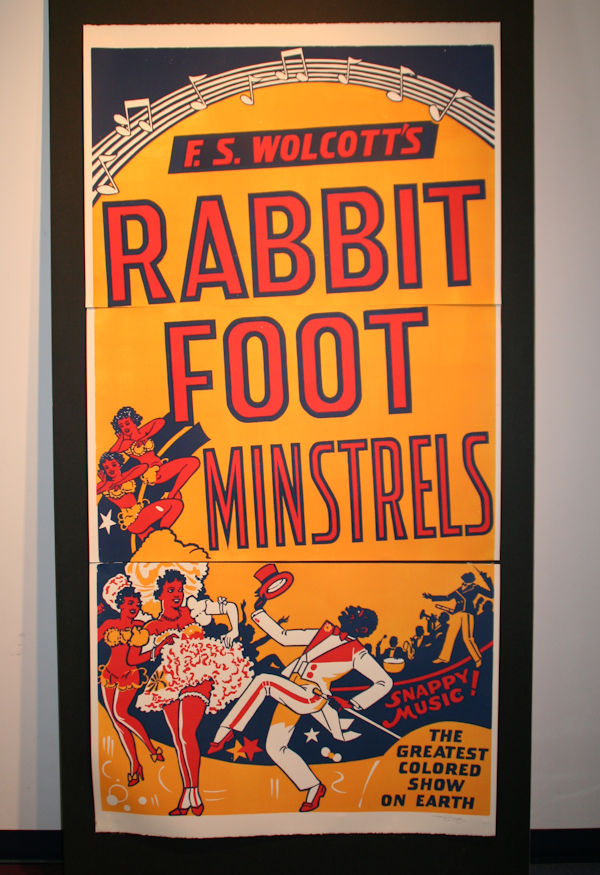
One of the exhibits:
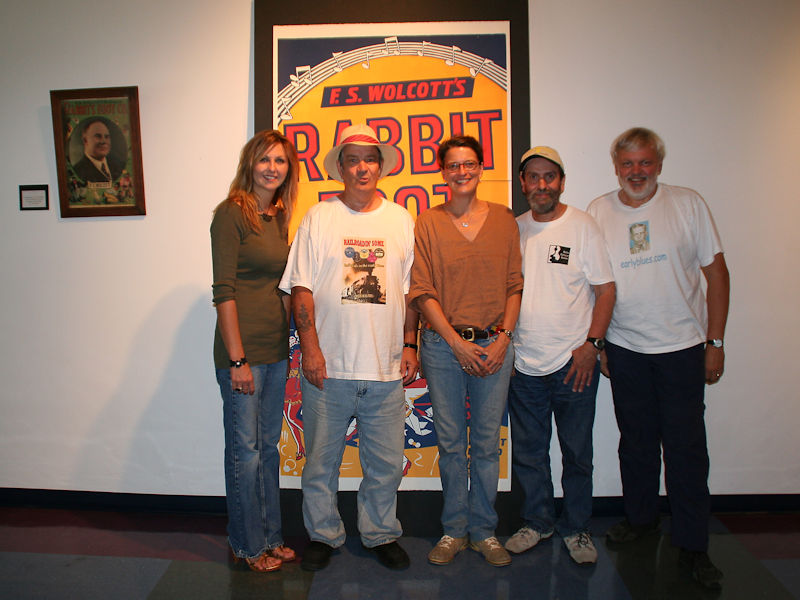
Visitors’ photo opportunity: LIsa (?), Max Haymes, Liza Schnabel, Rex Haymes and Alan White.
LIsa and LIza were representing the Martin & Sue King Railroad heritage Museum; Max, Rex and Alan were on the book signing tour:
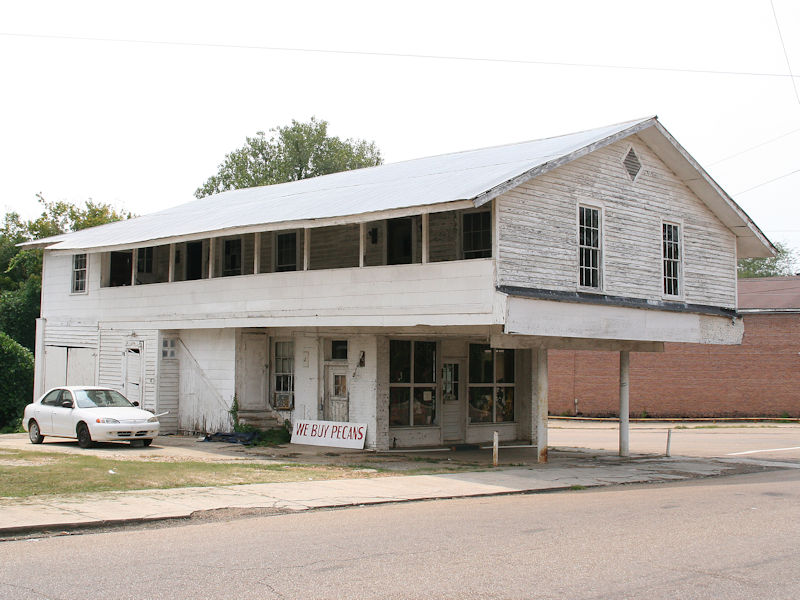
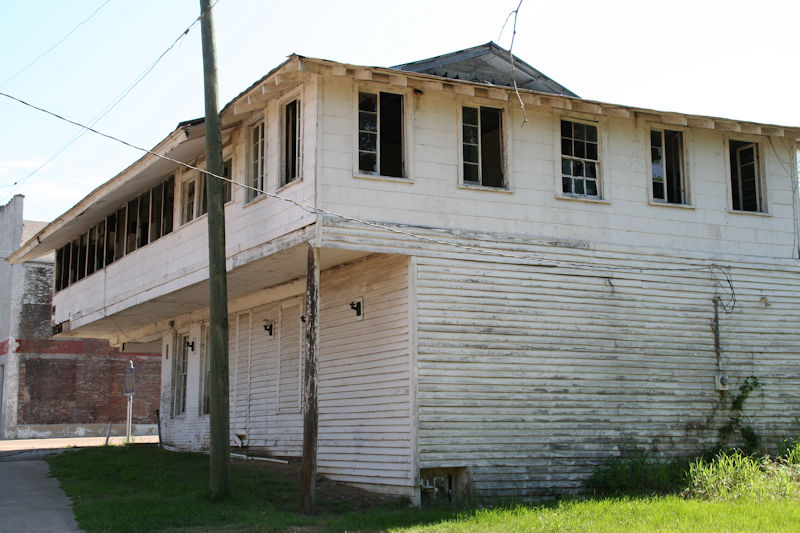
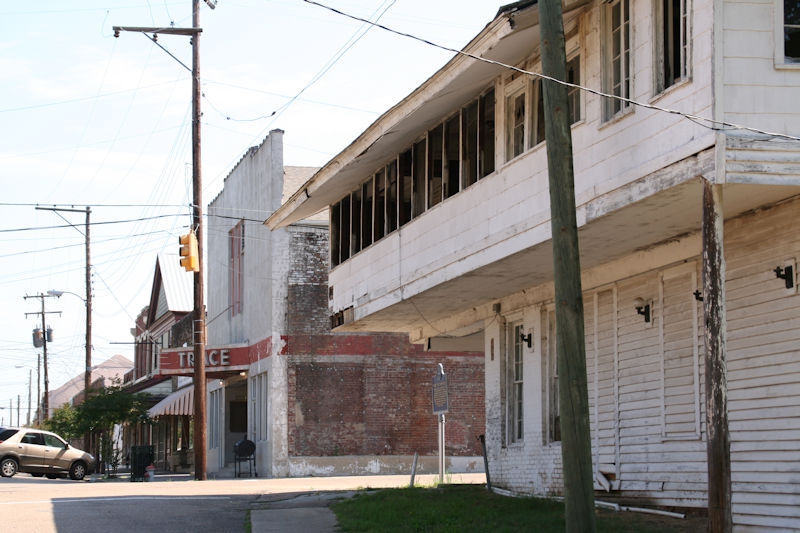
An abandoned service station and former hotel building which was once reportedly home to the Rabbit Foot Minstrels, prior to the Mississippi Blues Trail marker at the building’s location. Tragically the bulding was burned down in 2015.
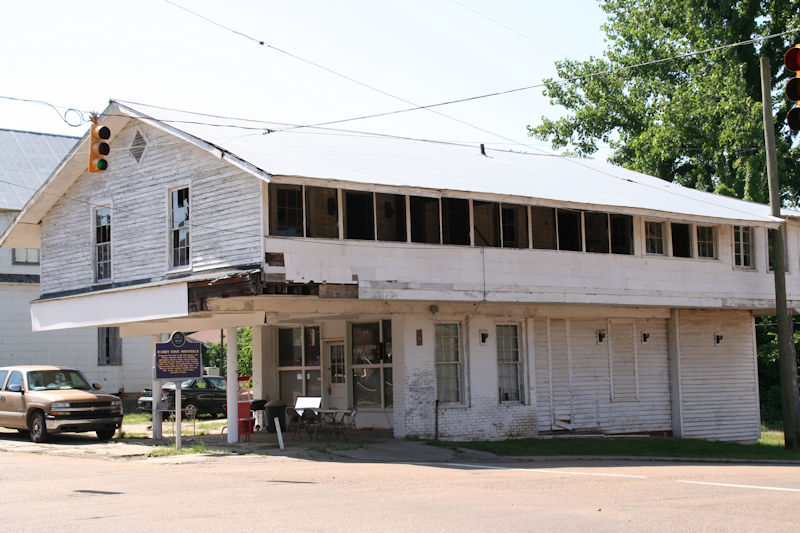
Here are three later photos taken in 2008, looking rather more delapidated – also with the Mississippi Blues Trail marker:
Following the visit Max wrote a short piece on the Rabbit Foot Minstrels which is published on this website here: